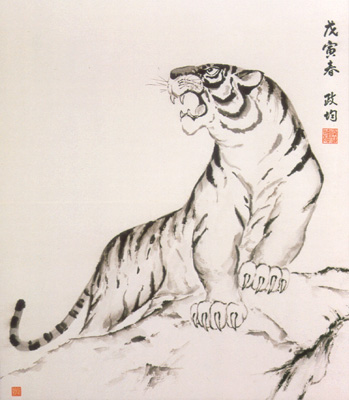
All Men Are Brothers – [Shui Hu Chuan] – Prologue #9
“CHANG, THE HEAVENLY TEACHER, CHIEF OF THE TAOISTS, BESEECHES THE GODS TO DRIVE AWAY THE EVIL FLUX. THE COMMANDER HUNG, IN HEEDLESSNESS, FREES THE SPIRITS.”
Again the Commander said, “Truly had I no strength to walk, and even as I thought to climb higher up the ridge I saw come out from among the pines an acolyte riding upon an ox and he blew upon a metal flute. Even as he came around the ridge I asked him whence he came and if he knew who I was and he knew all and he said The Heavenly Teacher had already mounted a crane and riding the clouds had gone that morning to the capital city. For this reason did I return.”
The abbot said, “Pity is it that the Commander has lost such an opportunity! This acolyte was The Heavenly Teacher himself.”
The Commander asked, “If he was The Heavenly Teacher then how did he look so common and so small?”
The abbot answered, saying, “This generation of heavenly teachers is not usual. Although his years are few, yet is he high in the true way. He is one outside the ranks of men and he is everywhere in every sort of guise and truly is he miraculous. Men on earth call him He Whose Wisdom Fills The Heavens.”
The Commander replied, “Is this what manner of man I am, that although I have eyes yet could I not discern the true Heavenly Teacher! I have seen his face and missed the knowing I did!”
The abbot said, “Pray let the Commander’s heart be at rest. If The Heavenly Teacher announced that he had gone already, then wait until the day you return to the capital and by then the great mass will already have been said.”
The Commander listened to this, and only then did he let his heart rest. Then did the abbot bid a feast be prepared to entertain the Commander and the Emperor’s mandate was preserved in the imperial casket and it was placed there in the temple and the dragon incense was burned in The Hall Of Three Clearnesses.
On that day in the guest hall there was prepared a great vegetable feast and wine was poured forth. When the night was come and the feast over, the Commander slept there until the morning.
<Continued – Prologue #10>
Onegaishimasu
I remember a quote from Albert Einstein : "Only two things are infinite: The universe and human stupidity. And I am not so sure about the former."
In real life, we tend to forget many things. When we are busy at work, we forget about family. When we pour so much attention to our family, we forget about personal fulfillment. And so on. I don't think this has anything to do with human stupidity, though; but if we cannot enjoy anything in everything we do for our life, it sure is stupid.
My blog is all about sharing. I am interested in many subjects, but most of them will fall into 4 categories : related to Work (Design/IT/Management), Fun (Entertainment/Games), Aikido & Read(ing). I hope my posting maybe of your interest as well, or the least to snatch your attention a while off your routine.
Oh, and about human stupidity; it is indeed stupid to think that learning process stops when you obtain a degree, certificate or a piece of paper for that matters. I've met so many academic people who proudly put down so many titles on their name card, yet their English language skills are somewhere between a kindergarten's and a polar bear's. When we live our life, we still learn so many things from everything around us. So that's where my tag-line comes from : Enjoy Life While We Learn :-)
Last but not least, I want to share a quote from my favorite TV series, Scrubs : "Life is like having a cup of coffee. If you don't find someone else, you'll end up drinking alone." Make friends, not war. Have a great day !
Tuesday, December 28, 2010
Friday, December 17, 2010
All Men Are Brothers – [Shui Hu Chuan] – Prologue #8
“CHANG, THE HEAVENLY TEACHER, CHIEF OF THE TAOISTS, BESEECHES THE GODS TO DRIVE AWAY THE EVIL FLUX. THE COMMANDER HUNG, IN HEEDLESSNESS, FREES THE SPIRITS.”
Then was the Commander afraid and he said, “You are but a cowherd, and how do you know?”
The acolyte laughed and said, “In the morning I serve The Heavenly Teacher in his temple and I heard him say, ‘Today the Son Of Heaven has sent a Commander Hung to me and he comes bearing the imperial mandate and the jade censer and he comes here on the mountain and he would have me got to the capital to make a mass of three thousand six hundred chants and so drive away the plague. Therefore will I mount a crane and ride the clouds and go thither.’ By now I do think he is gone, for he is not in the temple. Do not go up then for on the mountain there are fierce tigers and wild beasts and even your life may be lost.”
The Commander said, “Do not lie to me.”
Then the acolyte laughed and answered nothing but again he blew upon his flute, and so he turned to the other side of the ridge. The Commander thought to himself, saying, “But how is it this little lad knows everything? I believe The Heavenly Teacher must have commanded him to come and speak to me thus. Truly must this be so. When I think of climbing further and of how frightened I have been just now, better would it be if I returned.”
So the Commander took up the censer and sought again his old path and he hastened down the mountain. All the Taoists met him and he sat down in the guest hall and then the abbot asked him, “Did you see The Heavenly Teacher?”
Then the Commander said, “I am an honored official in the imperial court and how was it you bade me climb that mountain road and suffer thus? Truly might I all unknowing have lost my life. When I head gone half up the mountain there leaped out upon me a slant-eyed white-browed tiger and he frightened my souls and spirits clean away from me. Again I had not passed through more than on valley up the mountain when out of the viny bamboos there sprang a great snowy-spotted serpent and he heaped himself into circles and cut off the road I must go. If my destiny had not been greatly good how could I have come back with my life? – But it was all because of you Taoists who thought to make a joke of a high lord!”
Then the abbot replied, saying, “And how would such poor Taoists as we dare to treat so mighty a lord thus lightly? Nay, this tiger and this serpent were trials sent by our Heavenly Teacher to try your heart, for although there be tigers and serpents on this mountain of ours they are not such as harm men.”
<Continued – Prologue #9>
Friday, December 10, 2010
All Men Are Brothers – [Shui Hu Chuan] – Prologue #7
“CHANG, THE HEAVENLY TEACHER, CHIEF OF THE TAOISTS, BESEECHES THE GODS TO DRIVE AWAY THE EVIL FLUX. THE COMMANDER HUNG, IN HEEDLESSNESS, FREES THE SPIRITS.”
Again he went on some thirty to fifty paces and he drew several deep sighs and he said resentfully, “The Emperor set me a certain day to come here and he has made me suffer such fear as this ---“
Before he finished speaking he perceived again a great wind rising there and it blew a poisonous breath toward him. When the Commander stared into it there was a sound of hissing among the vines in the bamboos and there came forth a white-spotted serpent as large around as a bucket.
The Commander saw it and again he leaped in terror. He case aside his censer and shouted out, “This time am I dead indeed!” And tumbling backward he fell beside a ledged rock. Then he saw the serpent writhe quickly toward to rock and facing him it heaped itself into a pile of circles and out of its two eyes gleamed yellow light and opening its great mouth it thrust out its tongue and blew its poisonous breath into the man’s face.
The Commander was in such terror his three souls floated from his body and his seven earthly spirits left him. That serpent stared awhile at the Commander and at last winding down the mountain was seen no more. Only then did the Commander crawl to his feet again and he said, “Fortunate! But I am killed with fright.”
When he looked at himself there were spots on him as big as dumplings and he began to curse the Taoists, saying, “These hateful, cursed, virtueless ones – they make these tricks on me and make me suffer such fears as these! If I cannot find The Heavenly Teacher on the mountain top then shall I have more to say to them when I go down.”
Again he lifted up the censer and set straight the mandate and ordered his clothing and was about to go on again. Even as he lifted his foot to step he heard in the pines the faint sound of a flute coming near and nearer. When he fixed his gaze to see, he saw an acolyte sitting backward on an ox and blowing on a metal flute and smiling as he came. The Commander watched him come and he called, “From whence have you come? Do you know who I am?”
But the acolyte paid no heed to him and he did but blow his flute. The Commander asked him yet several times more and at last the acolyte laughed a great ho-ho and taking the metal flute from his lips he pointed with it at the Commander and he said, “Do you come hither to see The Heavenly Teacher?”
<Continued – Prologue #8>
Friday, December 3, 2010
All Men Are Brothers – [Shui Hu Chuan] – Prologue #6
“CHANG, THE HEAVENLY TEACHER, CHIEF OF THE TAOISTS, BESEECHES THE GODS TO DRIVE AWAY THE EVIL FLUX. THE COMMANDER HUNG, IN HEEDLESSNESS, FREES THE SPIRITS.”
Then the Commander parted from them and repeating the name of the Taoist god he left his feet free and strode up the mountain. He went on thus alone awhile and he rounded the cliffs and followed the narrow path and pushed aside the vines and grasses.
“CHANG, THE HEAVENLY TEACHER, CHIEF OF THE TAOISTS, BESEECHES THE GODS TO DRIVE AWAY THE EVIL FLUX. THE COMMANDER HUNG, IN HEEDLESSNESS, FREES THE SPIRITS.”
Then the Commander parted from them and repeating the name of the Taoist god he left his feet free and strode up the mountain. He went on thus alone awhile and he rounded the cliffs and followed the narrow path and pushed aside the vines and grasses.
When he had gone over several ridges and more than a mile or so he felt his feet give way and his legs were suddenly strengthless, and truly could he go no further. He was silent now and he pondered, and in his heart he said, “I am an honored minister of the imperial court and when I am in the capital I cannot rest unless I have to mattresses under me and when I eat it must be from many dishes and even then am I wearied much. How then can I suddenly put straw sandals on my feet and walk up such a mountain as this? And how do I know where this Heavenly Teacher is that one like me should suffer so?”
He had gone but thirty or fifty paces more and his shoulders were heaving with his panting when suddenly between two mountains he saw a great wind rise. When this wind had passed there came after it a great noise like the clap of mighty thunder from behind the pine trees and there leaped out suddenly a white-browed, slant-eyed, many-hued tiger.
The Commander gave a start of terror and he shouted out, “Ah Yah!” and he fell backward. The great tiger stared at him and begin to circle first to the left and then to the right and it roared awhile and then went leaping down the crags to the back of the mountain.
Now the Commander had fallen at the foot of a tree and all his thirty-six teeth clattered together and his heart beat as though it were a well with fifteen buckets going up and down together in it. His whole body lost its sense as though he were paralyzed and his two legs were weak as vanquished cocks. Without ceasing he cried out bitterness.
After the tiger had left him he lay for about the space of the drinking of a cup of tea and only then could he clamber to his feet and he mended the incense in his censer and lit the incense and again he went up the mountain determined to find The Heavenly Teacher.
<Continued – Prologue #7>
Monday, November 29, 2010
All Men Are Brothers – [Shui Hu Chuan] – Prologue #5
“CHANG, THE HEAVENLY TEACHER, CHIEF OF THE TAOISTS, BESEECHES THE GODS TO DRIVE AWAY THE EVIL FLUX. THE COMMANDER HUNG, IN HEEDLESSNESS, FREES THE SPIRITS.”
So was mandate placed for the time in the midst of the temple and all those who had come went into the guest hall and the Commander sat himself in the center. Then was tea brought thither and immediately vegetarian food was brought in and among these not one sort of vegetable food was lacking whether from water or from land. When the meal had been eaten the Commander again asked the abbot, saying, “If The Heavenly Teacher is in the little temple on the crest of the mountain why may one not go thither and invite him to come down that he may open the mandate of the Emperor and read it?”
The abbot answered humbly, “This generation of Taoists who is upon the crest of the mountain has reached a very high stage and he can bridle the mists and ride upon them and where no clouds are he can make them rise and he leaves no footsteps behind him. Such Taoists as we are cannot easily see him. How then can we send one and invite him to come down?”
The Commander said, “If it be so, then how shall we see him? The plague in the capital is fierce passing belief and so did the Son Of Heaven bid me to come hither bearing this mandate which was written even by the imperial hand itself. And I come myself bearing the dragon incense! And I come to invite The Heavenly Teacher that he will lead a great mass of three thousand six hundred chants and so spread a net for Heaven and thus drive away the plague and save the lives of all the people. But if it be thus with him, then how shall we do it?”
Then the abbot said respectfully, “If the Son Of Heaven would save the lives of the people, the Commander must use a pure heart. You must eat only vegetable food and bathe your body and change to cotton garments and take no man with you and yourself you must bear the imperial mandate and with the imperial incense lighted go up the mountain on foot and worship The Heavenly King and bow before him and invite him. Thus only may The Heavenly King be seen. But if your heart be not pure then will it be but vain that you go and hard will it be to see him.”
The Commander heard this and he said, “From the day I left the capital I have eaten no meat and is my heart not pure? If it be thus then I will do as you say. Tomorrow at dawn will I go up the mountain.”
That night did each go therefore to his rest. On the next day at the fifth watch all the Taoists rose and they prepared a fragrant hot water and asked the Commander to rise and wash his body. All his garments were changed to ones of cotton thread, new and such as had never been worn before by man. Upon his feet were hempen shoes and straw sandals. When he had eaten a vegetarian meal he fetched the imperial mandate and he wrapped it in a yellow silk kerchief and bound it on his back. In his hand he bore a silver censer and in it smoked the imperial incense. Many of the Taoists and priests escorted him to the mountain’s foot and then they pointed out the path that he must take. Again did the abbot humbly say, “If the Commander would save the people let not your heart repent itself or think to turn back. With all your heart then go upward!”
<Continued – Prologue #6>
Thursday, November 25, 2010
All Men Are Brothers – [Shui Hu Chuan] – Prologue #4
“CHANG, THE HEAVENLY TEACHER, CHIEF OF THE TAOISTS, BESEECHES THE GODS TO DRIVE AWAY THE EVIL FLUX. THE COMMANDER HUNG, IN HEEDLESSNESS, FREES THE SPIRITS.”
Then was the imperial incense burned in the palace and the Emperor himself gave the mandate he had written on red paper to the minister, who was the Commander Hung. Straightway he went forth with the imperial mandate and he bade farewell to the Emperor and he bore the mandate on his shoulder and put the imperial incense in a box and he led with him some tens of men. They all mounted each his horse and they all followed him and so they left the capital.
They followed the road then and they went straight toward the city of Hsin Chou to a little town called Kuei Ch’i. In less than a day they came to the city of Hsin Chou in Kiangsi. The officials of the city great and small came forth to meet them and straightway they sent men to announce the matter to the abbot of the temple in The Mountain Of Dragons And Tigers to prepare to receive the imperial mandate.
On the next day all the officials escorted the Commander Hung to the foot of The Mountain Of Dragons and Tigers and there from The temple Of Upper Clearness they saw many Taoists coming down, their bells chiming and drums beating, and they carried incense and flowers and lanterns and candles and banners and canopies and many instruments of music, and they all came down the mountain to meet the imperial messenger. He came straight to the temple before he came down from his horse. Then did they all, from the abbot to the least acolyte, circle about to greet him and they escorted him into The Hall Of Three Clearnesses and they besought him to set up the imperial mandate in their midst.
And the Commander asked the abbot, saying, “Where is The Heavenly Teacher now?”
The abbot came forward and said humbly, “Thus will I tell the Commander. The one of this generation of these many generations has a notable name, The Heavenly Teacher Of Empty Peace, and his temper is very lofty and remote from men. Hard is it for him to do such work as to meet guests or speed them. He has built a thatched temple for himself upon the crest of the mountain and there he lives alone, purifying his spirit. Because of this he does not live here in our temple.”
The Commander said, “But now there comes a mandate from the throne commanding him thither and how may we see him therefore?”
The abbot answered, saying, “Pray let me speak. For the time let this mandate be placed here in the temple, for none of us common priests dare to open it. Let the Commander then go into our guest hall and there drink tea and then may we take counsel together.”
<Continued – Prologue #5>
Tuesday, November 23, 2010
All Men Are Brothers – [Shui Hu Chuan] – Prologue #3
“CHANG, THE HEAVENLY TEACHER, CHIEF OF THE TAOISTS, BESEECHES THE GODS TO DRIVE AWAY THE EVIL FLUX. THE COMMANDER HUNG, IN HEEDLESSNESS, FREES THE SPIRITS.”
In the spring of the third year of the time called Chia Yu there was a great plague of sickness over the whole country and from the region south of the great river to the eastern and to the western capitals there was not one of the people who did not suffer from it. In every city and every town there were sent memorials to the throne in number like great drifts of snow.
Let it be told now of affairs within and without the eastern capital. The soldiers and the people had died to the greater half of all their numbers and in the city of K’ai Feng the minister Pao Chen spent all his own means in buying medicine for the people to heal their plague and many were healed. Yet how could they all be healed? The plague grew yet more grace and all governors both civil and military took council together and they all came into The Hall Of The Water Clock to wait for dawn to come, which was the time of imperial audience, so that they might announce the matter to the Emperor.
On this day, which was the third year of the time called Chia Yu, and the third moon and the third day, at the fifth watch and near to dawn, the Emperor sat in the audience hall and waited. When the rites of courtesy were over then did the master of ceremonies call forth and say, “Let him among you who has aught to say now come forth straightway. If there is no business, then roll up the curtain, for the Emperor retires.”
Then from among all the officials was there a certain minister named Chao Che and there was a lesser one, Wen Yien Po, and they came forth and said, “Now is the plague heavy upon us here in the capital city and many are the soldiers and the people who suffer from it. Let all crimes be forgiven, therefore, and let mercy be made wide. Let the imperial punishments be lightened and the taxes on the people lessened and thus let Heaven be besought.”
The Emperor hearkened to these words and he commanded the palace of the scholars that they were to send forth mandates straightway, commanding that all prisoners were to be freed from gaols and all tributes from the people were to be forgiven them. Beyond this a mandate was to be sent to all Buddhist and Taoist temples in the capital city that they were to say prayers so that this plague might pass away.
But beyond expectation the plague grew yet more heavy. The Emperor Jen Chung heard of this and his sacred dragon heart could know no peace. Again he gathered together all his ministers to take counsel with them. Now among the ranks of them as they stood there was a certain great statesman and he came forth regardless of his turn. The Emperor saw him and he was a minister named Fang Chung Yien. When he made his obeisance and had given greeting he said, “Now is the plagues most cruel and the soldiers and the people suffer very bitterly, nor can they rest from their fear day or night. According to my poor small purpose, if we are to drive out this plague we must call for the great Taoist who is descended direct from the times of Han to come hither and here in the palace let him call a mass for seven days and thus can we make our trouble known to God so that He may drive out this plague and so save the people.”
This the Emperor Jen Chung promised him and swiftly he bade his scholars put forth the mandate and he himself set his handwriting there and gave his own imperial incense to the Taoist. Then he bade the chief master of ceremonies, who was named Hung Shin, to be his messenger and go to the province of Kiangsi to The Mountain Of Dragons And Tigers and there invite the Taoist Chang Chen Jen, who was descended from the times of Han, to come that same night to beseech Heaven to drive out the plague.
Monday, November 22, 2010
All Men Are Brothers – [Shui Hu Chuan] – Prologue #2
“CHANG, THE HEAVENLY TEACHER, CHIEF OF THE TAOISTS, BESEECHES THE GODS TO DRIVE AWAY THE EVIL FLUX. THE COMMANDER HUNG, IN HEEDLESSNESS, FREES THE SPIRITS.”
Now at the great Western Mountain Hua there was a certain Ch’en T’uan, who was a Taoist hermit. He was a man of deep religion and of great virtue and he could divine the winds and the clouds. One day he rode an ass and went down the mountain and as he was going along the road that led to the great Hua Mountain, he heard the travelers by the way say, “The Emperor has given his seat to the officer Chao.” When Ch’en T’uan heard this he was pleased in his heart. He placed one hand over his brow and laughed there loudly upon the ass’s back so that he even fell to the earth with his great laughter. When men asked him for the reason of his laughing that scholar said, “From this time on peace will reign in our land. Truly is it Heaven’s will above that this Chao shall be Emperor and so it is in accord also with the kingdom of the earth beneath and between these, it accords also with the hearts of men.”
From this year of Ken Shen, Chao took the throne and he opened his dynasty. He reigned for seventeen years and all the earth was at peace. After him his brother reigned, the Emperor T’ai Chung, and he reigned twenty and two years and he gave the throne to the Emperor Chen Chung. Chen Chung gave it in turn to Jen Chung.
Now this Emperor Jen Chung was in truth The Barefoot God From Heaven and when he was born a mortal babe he wept without ceasing night and day. His father, the Emperor, put forth proclamations calling for some physician to come and heal his ill, and the very heart of Heaven was moved with pity. Then did Heaven send the god T’ai Po from a certain western star to come to earth and he changed himself into a very old man and he came and he tore down the imperial proclamation and he said that he could still the imperial babe’s weeping.
The guard who was in charge of the proclamation led him into the palace and there the old man saw the Emperor, and the Emperor commanded him to enter into the private palace and see the babe. The old man entered straightway and he lifted up the babe and he whispered certain words into the babe’s ear and the babe ceased its weeping. Now the old man would not tell his surname or his name, but those who watched saw him change into a wind and vanish.
And what were these words the old man told into the babe’s ear? He said, “The Star Of Wisdom guides you, the Star Of War protects you.”
And truly was it that Heaven sent these two stars down to aid this Emperor Jen Chung. The Star Of Wisdom was the most learned Pao Chen, he who was lord of the southern court in K’ai Feng and chief scholar of the imperial palace. The Star Of War was Ti Ch’ing, the great warrior who went to chastise the rebellious kingdom of Hsi Hsia. These two great statesmen came forth and they supported this Emperor and he reigned for forty and two years. From the first year he began to reign, called the year Kuei Hai, until the ninth year of the time called T’ien Shen, in those years the country was at peace and the harvests of the five grains were plentiful and the people went merrily to their work. If aught was dropped upon the road, none picked it up nor were the doors of houses locked at night. So it was during the first nine years.
From the first year of the period called Ming Tao until the third year of Huang Yu, these nine years were also filled with prosperity and these years were the second period. From the fourth year of Huang Yu to the second year of Chia Yu, these nine years the fields bore more heavily yet, and this was the third period. Thus these three periods passed, twenty-seven in all, and they were called the three periods of greatest peace and prosperity. Then did the people rejoice. But who could foresee that joy must end and sorrow come?
Saturday, November 20, 2010
All Men Are Brothers – [Shui Hu Chuan] – Prologue #1
“CHANG, THE HEAVENLY TEACHER, CHIEF OF THE TAOISTS, BESEECHES THE GODS TO DRIVE AWAY THE EVIL FLUX. THE COMMANDER HUNG, IN HEEDLESSNESS, FREES THE SPIRITS.”
But at last the clouds parted to show the clear sky,
For a hundred years the grass and the trees
Received once more the sun and the dews.
Peace reigned again over river and hill,
Men walked in silk robes everywhere at will.
Forth from the houses did music sound,
Peaceful the days passed idly by;
Endless the songs of the golden birds,
Endless the life of the blooming flowers,
Though the sun was high, yet was sleep profound.
It is said : These lines of verse were written by a famous scholar in the reign of the Emperor Shen Chung in the times of Sung now past. His surname was Shao, and his name was Yao Fu and he was otherwise named The Peaceful And Faithful. Now these were troublous years at the end of the T’ang Dynasty in the times of the Five Kingdoms, such times that in the morning the country belonged to the Liang Dynasty and by evening to the Chin Dynasty. Truly was it as men said,
“Chu, Li, Shi, Liu, Kuo,
Liang, T’ang, Chin, Han, Chou,
In these five dynasties
Fifteen emperors reigned,
Fifty years they roiled the land.”
Then was the very heart of Heaven moved and according to Heaven’s law the wheel turned and times changed. In the town of Chia Ma there was born the first Emperor of Sung, The Great Conqueror. When this great wise man was born a red light shone over the whole sky and the air was filled with varied fragrances, nor were they dispelled the whole night through. In truth he was the God Of Thunder And Lightning himself, born from above into human flesh, and he was a brave and fierce and heroic man. His intelligence, his tolerance, were supreme, nor was there ever any Emperor to compare with him. With his staff in his hand he marched on and conquered five hundred cities until they all acknowledged him. That Emperor indeed swept clean the land and washed away all evil from it.
The name of his empire was The Great Sung and his capital was in P’ien Liang, or K’ai Feng. Through nine dynasties and eight Emperors he was considered chief and he was first Emperor of four hundred years of the Sung Dynasty. Because of this Shao Yao Fu, the scholar, praised him, saying, “But at last the clouds parted to show the clear sky.”
Truly was it as though again and at last the people saw a day of sun.
Friday, November 19, 2010
Aikido - Among Other Martial Arts - Part #3
Excerpt from : "The Elements of Aikido" by Greg O'Connor
In an actual life-and-death confrontation the attacker can, and often will, resort to any means at hand to ensure success. Your resourcefulness and self-defence abilities determine the outcome. This means that you, as an aikidoist, must be constantly vigilant throughout your performance of the Aikido technique. You must remain alert for any opportunities your partner may have. They can execute additional strikes or grabs, introduce weapons, or be jointed by others helping in the attack. Therefore, as abilities advance, the aikidoist must be aware of not only one partner's full capabilities but also the possibility of multiple attackers; and to still neutralize those attempts easily, efficiently and ethically.
Though practised as a martial art with these critical martial points in mind, the ultimate idea of Aikido is to bring people together. To create calm out of chaos; to find our common condition, to break down our feelings of separateness from one another and, in doing so, also break down our feelings of separateness from everything.
Typically, many who are attracted to Aikido have already experienced competition. They may no longer seek the forum of one-on-one contests to define or enhance their characters. Contests and competitions are very good, of course, for developing such qualities as determination, tenacity, teamwork and fair play. Aikido develops these same qualities but in an alternative context, with the most intimidating foe any of us will ever face - our own psyche. It is our own psyche's patterns of conduct that can keep us from enjoying a peaceful and happy life.
In Aikido training you work with men and women - big, small, strong, weak, scared and scary. You have to recognize what each unique individual does to your internal equilibrium; what effect their presence, mood, energy level, personality and so on have on you; how they affect the interaction and outcome when practising the various Aikido techniques.
Many other martial arts have what can be loosely described to as a 'boot camp' atmosphere with a militaristic approach to training. The discipline can be harsh and even severe. This, like a training camp, certainly has the effect of forging character, developing perseverance and individual will-power. It can enhance personal discipline, increase individual tenacity and fortitude, implant respect and adherence to authority, and impart the advantages of teamwork. The advantage of Aikido training is that it includes these very same benefits. With Aikido, however, they are brought about by alternative methods involving co-operation and compassion - and in an alternative context based on friendship and peaceful camaraderie.
Many of the people who find Aikido attractive do not need or desire training camp methods. They may have, as the saying goes, 'been there, seen it, done it, got the T-shirt'. Some have even had extensive experience, attained significant rank in another discipline, and wish to move on to expand their horizons. Commonly, many do not feel the need to prove anything to anyone else and wish to enrich themselves in other ways.
'True victory,' Aikido's founder said, 'is victory over self.' If you can claim that victory and bask in its glow then you have already won over every other opponent and situation that will come before you. This is a very real challenge, as we all know, because this type of victory is only attained after meeting and accepting the challenge of all challenges: to maintain our composure, our balance, our peace, as often as possible, if not always. In Aikido, this victory - to be able to use that state of balance to act with evolved appropriateness - is the goal and the reward.
Monday, November 15, 2010
Aikido - Among Other Martial Arts - Part #2
Excerpt from : "The Elements of Aikido" by Greg O'Connor
Some other arts can be considered linear and static, insisting on maintaining one's position regardless of the force coming in. Attacks are blocked and deflected. In order to effectively perform those blocks conditioning of the forearms and shins is needed, resulting in tissue bruising and damage, calluses, calcium build-ups on the bone from hairline fracturing, and general trauma of the body. Aikido does not require such conditioning.
In Aikido, the attack is not blocked, but blended with. It is not deflected; it is redirected. Force is not met with direct force. We blend with the attack's force, adding our own balanced energy to it and sending it safely by us. We can describe Aikido as being non-linear, circular and fluid. We maintain our position by moving it. Our body movement, not our body, absorbs the power of the attack. When the attack comes in, the aikidoist envelops it, at the same time adjusting safely to a new position while guiding the passing attack safely away.
Other arts may also use similar principles (ie, absorption and redirection) but often conclude the interaction with the more violent options of striking or kicking. Some have only limited interaction with a live practice partner and some not at all, preferring solitary practice, but in Aikido you must practise with a partner. Aikido requires personal interaction with its various degrees of commitment and intensity. Just as you cannot learn to ride a horse without the horse, you cannot learn to blend Aikido technique to another's attack without that other person. You must see the other person before you; you must feel his or her presence, and how it affects your heart.
Other martial art systems are typically competition based. They have contests and tournaments where qualities of assertion and fortitude are brought out and developed. These qualities represent the healthy side of competition. The down side is that overemphasis on competition may develop into aggression. Assertion is desirable. Aggression is not. It can lead one to the assumption that 'might makes right' or 'to get what you want you have to fight'. This may also lead to the belief that you must defeat someone else in order to achieve your goals. In Aikido we strive for a more evolved approach. Through principles based on respect, co-operation and benevolence Aikido strives for mutual benefits resulting from any interaction. Using Aikido, we are hoping to have learned something from the struggles of those who have gone before us; something that not only allows us to survive as individuals, but also as a responsible and continually evolving species.
Other arts pit the practitioner against one solitary opponent. These contests, being essentially sports contests, require participants to follow specific rules, necessary for safety and good sportsmanship. Because of this the full range of the opponent's attack capabilities and options is restricted. They are sports contests where a sort of gentlemen's Marquis de Queensbury rules apply. In a real-life physical assault there is no such thing as sportsmanship. These sport combatants do not have to be concerned with such things as unnecessary roughness, biting, vitals being viciously attacked, eyes being gouged out, the introduction of weapons, or additional attackers coming at them simultaneously.
Traditional Aikido, as conceived by Morihei Ueshiba, has no contests, competitions or tournaments. Some Aikido styles, such as Tomiki style, do have competition. That may be fine for those who wish to compete but, nevertheless, it is contrary to the basic philosophy of traditional Aikido.
The competition that traditional Aikido encourages is the one that endeavours to improve upon and evolve our own characters, to balance ourselves, and to correct and refine our own behaviour patterns. The founder of Aikido said that it was not an art for correcting others, but for correcting our own minds. The battle is not with an outside enemy, but with the inner demons that work to prevent us from living a life of deep fulfillment and contentment - a life of true peace. The competition is in the challenge to balance ourselves on all levels - physical, mental, emotional and spiritual - regardless of the situations in which we find ourselves. The challenge is also to accomplish all this on our own merit, not at the expense of damaging another's health or well-being, or resorting to the defeat of someone else; destruction and violence are undesirable alternatives. The ideal result of Aikido training is to simultaneously better ourselves and others, whether they are attackers or supporters.
The rules contained within competition restrict an opponent's full options, limit the contest to one attacker, and foster a certain level of complacency. This is something that can be very detrimental in a real-life attack. With Aikido training we assume the attacker is not going to 'stick to the rules'. Using any of our Aikido techniques in an actual self-defence scenario, we must be able to neutralize one attacker and still use them to effectively shield against any further attacks. All this is done while retaining the option to throw one attacker into the others in order to stop or impede them.
<Continued – part 3>
Saturday, November 13, 2010
"NGOBAMA" by Budiarto Shambazy
KOLOM POLITIK EKONOMI (http://koran.kompas.com/read/2010/11/13/02454821/ngobama)
"Ngobama" | Budiarto Shambazy | Sabtu, 13 November 2010 | 02:45 WIB
Saya yakin andai ada sesi tanya jawab dalam pidato di Balairung Kampus UI, Depok, Rabu (10/11), banyak hadirin yang curhat kepada Presiden AS Barack Obama. Soalnya dia mendadak jadi pemimpin idola yang kita rindukan walau cuma mampir di Jakarta 19 jam saja.
Curhat pertama begini. ”Bapak dua kali membatalkan lawatan ke sini karena bencana kebocoran minyak Teluk Meksiko dan memperjuangkan RUU jaminan kesehatan. Kenapa para pemimpin/politisi kami malah ke luar negeri saat ada bencana di Wasior, Mentawai, dan Merapi?”
Curhat nomor dua lain lagi. ”Bapak warga minoritas, tapi bisa jadi presiden. Kok bisa? Sukar dibayangkan itu terjadi di sini karena hampir semua etnis dan agama minoritas dimusuhi atau diserbu. Pemerintah berpangku tangan saja!”
Sekarang curhat nomor tiga. ”Pak, apa benar mau membantu pemberantasan korupsi? Kalau benar, tolong cepat-cepat kirim agen-agen FBI menyidik korupsi Century. Kalau bisa, kerja sama kemitraan strategis mencakup pula bantuan ahli-ahli AS mengurai banjir dan macet Jakarta!”
Pidato Obama bukan saja mengundang curhat, tetapi juga tangis. Saya dua kali diundang menyaksikan pidatonya ketika merayakan kemenangan Pilpres 2008 di Chicago, November 2008, dan dilantik sebagai presiden di Washington DC, Januari 2009.
Ratusan warga mewek, mulai dari yang menangis meraung-raung sampai yang hanya menitikkan air mata. Mereka yang menangis tak pandang bulu: tua, muda, kaya, miskin, hitam, putih, sendiri-sendiri, atau beramai-ramai. Saya bersumpah ikut sedikit terharu!
Jika berpidato, Obama memang enggak pernah curhat. Tetapi, ia reach out mendengarkan curhat rakyat. Akibatnya, rakyat merasa punya teman berbagi dan berharap hidupnya bisa lebih baik. Itu sesuai dengan slogan kampanye kemenangan Obama, ”Yes We Can” (Bersama Kita Bisa).
Mengapa Obama pandai menampung curhat? Kini saya tahu jawabannya: 50 persen karena ia orang awam yang tak sudi berpura-pura dan 50 persen karena rakyat kecewa kepada Presiden George W Bush selama delapan tahun memerintah.
Obama sebenarnya kurang pandai berpidato, makanya ia disarankan tetap memakai teleprompter. Namun, ia jujur dalam menyampaikan isi dan cara menyampaikan pidato dengan gaya profesor rendah hati. Seperti kata pepatah, the singer, not the song.
Rakyat AS tergila-gila kepada Obama karena sebal kepada George W Bush. Fenomena ini lebih kurang sama dengan yang dialami 5.000 hadirin di Balairung UI, yang tergila-gila pula kepada Obama karena merasa sebal terhadap kelakuan para pemimpin kita.
Jadi, ”Obamania” di sini cuma sekadar kompensasi politik. Kini di negaranya Obama mulai menghadapi masalah, tetapi popularitasnya tak menurun drastis, masih rata-rata 40 persen. Dan, sampai sekarang ia praktis belum tersaingi untuk jadi presiden 2012-2016.
Nah, Obama sebenarnya bukan melawat, cuma ”mampir” ke Jakarta dari India, on the way ke Korea Selatan dan Jepang. Kita boleh saja gembira karena rakyat Australia dan Guam pasti kecewa batal dikunjungi oleh ”Obama the rock star”.
Meski tak pernah menulis lagu dan menjual CD, karisma Obama tak kalah dibandingkan dengan Mick Jagger. Mereka mampu menyedot puluhan ribu penonton sekali manggung. Makanya Obama ngotot mau pidato di UI untuk reach out ke berbagai kalangan yang diwakili 5.000 undangan saja.
Tampak sekali Obama enjoy-enjoy aja. Buktinya ia bolak-balik ngomong Indonesia, menyimpang dari teks di teleprompter. Tiap kali mengucapkan bahasa kita, matanya berbinar dan senyumnya lebar memperlihatkan deretan giginya yang seperti permen Chiclets.
Setidaknya Obama menjawab curhat kita melalui tiga hal pokok: pembangunan, demokrasi, dan toleransi. Ia paham kesenjangan masih besar, demokrasi bermasalah, dan kebinekaan terancam. Tak heran ia paham tiga hal ini karena, katanya, ”Indonesia bagian dari diri saya.” Benar, untuk ketiga soal itu kita mungkin lebih tahu. Namun, kita kok baru sadar dan prihatin tiga soal besar tersebut masih saja melilit bangsa yang sudah merdeka 65 tahun ini justru ketika diucapkan oleh seorang Obama?
Jawabannya mudah: selama ini kita kurang sadar dan prihatin karena ketiga soal itu hanya diucapkan sampai pada tingkat wacana semata-mata oleh mulut-mulut pemimpin kita. Pidato mereka kosong tanpa makna karena mereka selalu ”lain kata lain perbuatan”.
Saya yakin Obama senang bukan kepalang walau cuma mampir. Buktinya ia bilang, ”Pulang kampung nih!” Setidaknya ia juga puas melahap habis berbagai suguhan yang bukan cuma sate dan bakso, melainkan juga tongseng, somay, gado-gado, sampai sop buntut.
Lawatan Obama tak lebih dari nostalgia belaka yang bersifat simbolis saja. Mungkin sebagian dari pejabat kita yang ”sok genting”, sampai-sampai sapi-sapi dan kambing-kambing kurban di pinggir jalan enggak boleh ikut nonton Obama karena ditutupi terpal.Saya harap Anda terhibur ikutan ngobama atau, dalam bahasa Inggris, Obama-ing. Arti nge dalam bahasa Betawi lebih kurang ”iseng saja”, misalnya nge-mal (iseng keliling mal). Untung dia hanya 19 jam di sini. Kalau enggak, banyak facebooker membuat grup ”Dukung Obama Jadi Presiden”.
Friday, November 12, 2010
Aikido - Among Other Martial Arts - Part #1
Excerpt from : "The Elements of Aikido" by Greg O'Connor
Martial artists have spent a thousand years perfecting both their internal and external balance. They have studied diligently to develop special skills that would enable them to meet life and its challenges in a relaxed, but alert and composed manner. They have sought to acquire the ability to respond quickly, effortlessly and with maximum efficiency in all situations. They have searched for an ideal art that would give them these capabilities. Aikido is such an art.
Most martial arts are based on the theory of self-protection and preservation. Aikido is based on the insistence of not only mutual protection and preservation, but also mutual growth and enhancement. Like most martial arts, it begins and ends with respect; but Aikido takes that a step further. It requires that he respect be maintained at a high level - throughout the interaction and even beyond - to all things at all times.
The main goal of most martial arts is to vanquish a foe. Wise leaders warn us, though, that a vanquished foe is still a dangerous one. Revenge and retribution are reactions common to us all. Even if our opponent has been completely destroyed, we may produce these desires in others, who may have been emotionally affected by our actions or who simply disagreed with us on their use. There are always going to be those that disagree with us and our actions - so why create even more?
Aikido's founder believed that it is not a technique to fight and defeat an enemy. It is a way to reconcile the world and make human beings one family. Aikido seeks the harmonious resolution of conflict in all its varied forms. It is a strategy for winning that, ideally, has no losers. It requires one to remain centered and balanced on all levels so as to recognize any attack, blend with it, and redirect it into a safe conclusion for all.
It is primarily a defensive martial art, preferring mainly defensive strategies. However, it can certainly be used, if necessary, to take the initiative once an attack is imminent. If moral judgment indicates an offensive response to deal with an attack, then Aikido easily has that capability. Many aikidoka may cringe at that statement, insisting that peace be maintained in all circumstances. I fully agree that this is the preferred ideal. But the additional reality is that there are predators in the world who would not only victimize you, but also your loved ones. Would you not rush to their defence without a second thought? Many people would because the protective instinct is a powerful one and it can be a potent ally. Since Aikido is an art of protection it can draw on that natural instinct to qualify its use and response. It gives credence to our protective nature and, with guidance, allows it to flourish.
In Aikido there is no attack per se. There are no aggressive strategies. We point out the openings and opportunities, known as tsuki, where strikes and kicks can be applied or executed. These are created during the actual execution of the Aikido technique itself. Knowing one has the option to take a more offensive approach at any point should give one confidence to be able to choose more ethical options to dispel the conflict. We also teach the new student how to execute a proper punch, strike, kick or grab in order to properly defend against them. However, we do not drill in those strikes or kicks. In arts that rely on offensive striking, practitioners are put through solitary kicking and punching drills, performing the same punch or kick over and over again. This is done so as to not only perfect its execution, but to make it second nature. The majority of the practice is spent repeating the same kick or strike hundreds of times, then moving on to practise another kick or punch in the same manner. It is interesting that a great many of the people that come to Aikido have already been through another art, usually one of the striking arts. They often wish to expand their horizons, either martially or morally, and have no need or desire to perform such drills.
In Aikido, as a basic practice, a single attack is performed and a specific Aikido technique is demonstrated by the instructor as a response against it. The students practise by repeating the entire sequence, alternating both left and right sides to develop symmetry, balance and ambidexterity.
Subscribe to:
Posts (Atom)